Design a high-density natural science Editorial Poster, merging Scientific Archive, Natural History Museum Visual and Experimental Graphic Design, emphasizing controlled chaos / 凌乱美. Four variants.
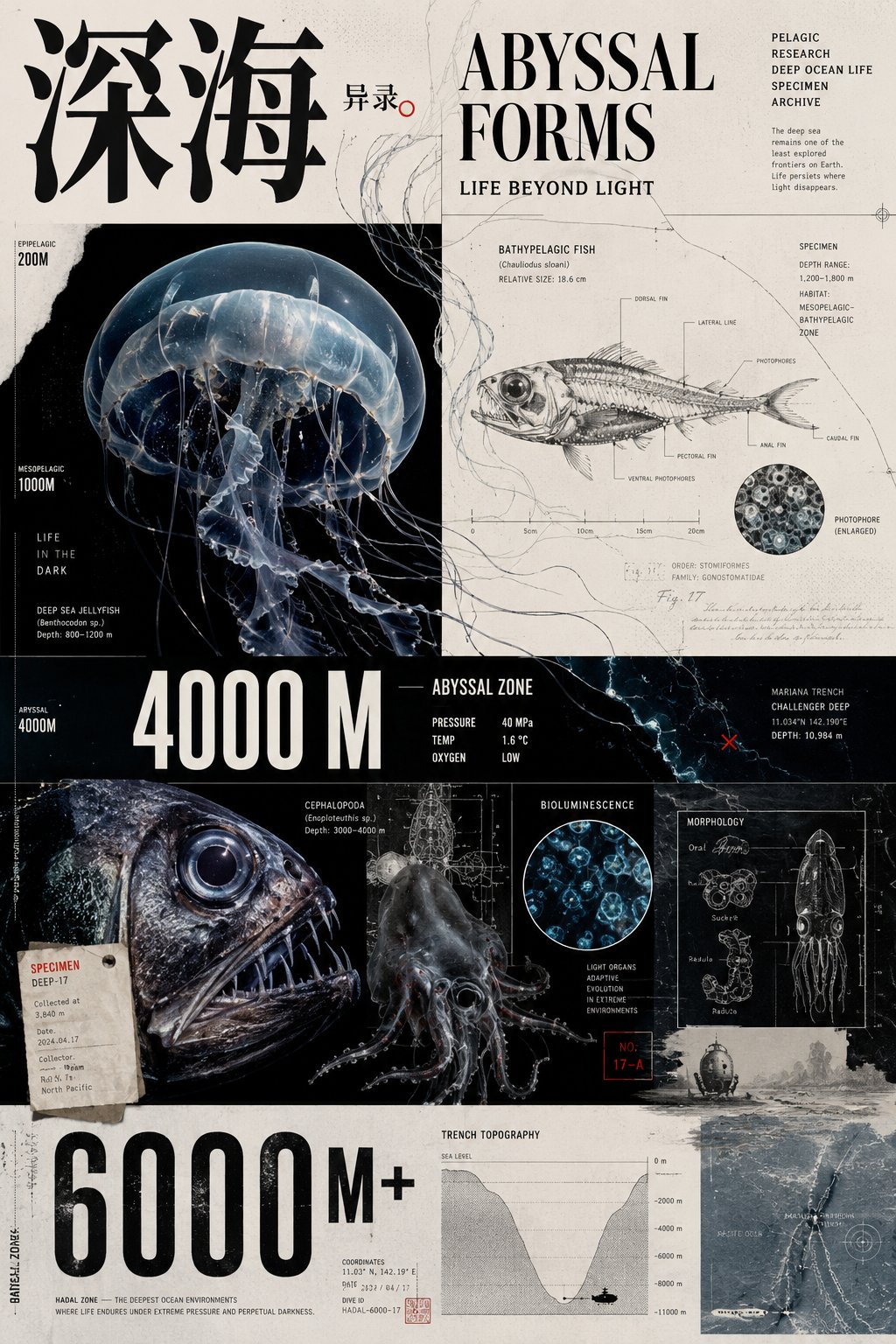
Variant 1 — 深海异录 (Deep Sea Chronicle):
[Theme]: deep sea × biological archive
[Main title]: 深海异录
[English title]: DEEP SEA CHRONICLE
[Core research subject]: deep-sea creatures — jellyfish, anglerfish and bioluminescent organisms
[Structural skeleton]: depth strata; jellyfish tentacles connect information blocks
[Scientific materials]: specimen photography, anatomical diagrams, microscope images
[Main + accent colors]: deep ink blue + warm ivory, with one coral-red accent
[Aspect]: 9:16
Variant 2 — 翼之谱 (The Anatomy of Wings):
[Theme]: insect × wing-vein structure
[Main title]: 翼之谱
[English title]: WING ANATOMY
[Core research subject]: insect wings — butterfly, dragonfly and beetle
[Structural skeleton]: wing veins forming the layout grid
[Scientific materials]: specimen photography, macro shots, anatomical line drawings
[Main + accent colors]: paper white + ink black, with one amber accent
[Aspect]: 9:16
Variant 3 — 矿物切面 (Mineral Sections):
[Theme]: mineral × geological fault
[Main title]: 矿物切面
[English title]: MINERAL SECTIONS
[Core research subject]: mineral crystals and rocks
[Structural skeleton]: fault lines cutting through the layout
[Scientific materials]: mineral photography, section diagrams, strata charts
[Main + accent colors]: raw earth gray + warm ivory, with one vermilion accent
[Aspect]: 9:16
Variant 4 — 生长解剖 (Growth Anatomy):
[Theme]: plant × growth system
[Main title]: 生长解剖
[English title]: GROWTH ANATOMY
[Core research subject]: plants — roots, stems and leaf veins
[Structural skeleton]: root and leaf-vein growth paths forming movement lines
[Scientific materials]: plant photography, botanical line drawings, microscope images
[Main + accent colors]: sage green + ivory, with one warm yellow accent
[Aspect]: 9:16
Overall: let the research subject's own structure directly participate in the layout, for example jellyfish tentacles connecting information, wing veins forming a grid, mineral faults cutting the page, root and leaf-vein growth paths. Mix real photography, scientific line drawings, microscope images, specimen labels, data charts and giant Typography, and design several visual sections of different natures. The sections connect through cropping, occlusion, crossing boundaries, misalignment and overlapping; do not make them independent regular modules.
Build an obvious scale contrast: huge titles / numbers + mid-size scientific info + very small metadata. Control the 'loose → dense → strong → negative space' visual rhythm, so some local areas are high-density and others suddenly empty.
Colors stay restrained, mainly 2-3 base colors + 1 small accent color, adding real textures such as paper, scanning, specimen archive and printing grain.
Final effect: scientific editorial design, specimen archive, macro-to-micro imagery, experimental typography, asymmetric collage, layered composition, museum-grade graphic design, controlled chaos.
Avoid: ordinary popular-science infographics, neat grids, evenly spread materials, children's-encyclopedia feel, main-image-plus-title template, all sections sharing one texture, or 'only chaos without a visual skeleton'.
设计一张高密度自然科学 Editorial Poster,融合 Scientific Archive、Natural History Museum Visual 和 Experimental Graphic Design,强调 controlled chaos / 凌乱美。共四种变体。
变体一·深海异录:
【主题】:深海 × 生物档案
【主标题】:深海异录
【英文标题】:DEEP SEA CHRONICLE
【核心研究对象】:深海生物——水母、琵琶鱼与生物发光生物
【结构骨架】:深度分层;水母触须连接信息板块
【科学素材】:标本摄影、解剖图、显微图
【主色 + 强调色】:深墨蓝 + 暖象牙白,点缀珊瑚红
【比例】:9:16
变体二·翼之谱:
【主题】:昆虫 × 翼脉结构
【主标题】:翼之谱
【英文标题】:WING ANATOMY
【核心研究对象】:昆虫翅膀——蝴蝶、蜻蜓与甲虫
【结构骨架】:翼脉形成版面网格
【科学素材】:标本摄影、微距、解剖线稿
【主色 + 强调色】:纸白 + 墨黑,点缀琥珀黄
【比例】:9:16
变体三·矿物切面:
【主题】:矿物 × 地质断层
【主标题】:矿物切面
【英文标题】:MINERAL SECTIONS
【核心研究对象】:矿物晶体与岩石
【结构骨架】:断层线切割版面
【科学素材】:矿物摄影、剖面图、地层图表
【主色 + 强调色】:陶土灰 + 暖象牙白,点缀朱砂红
【比例】:9:16
变体四·生长解剖:
【主题】:植物 × 生长系统
【主标题】:生长解剖
【英文标题】:GROWTH ANATOMY
【核心研究对象】:植物——根、茎与叶脉
【结构骨架】:根系与叶脉生长路径形成动线
【科学素材】:植物摄影、植物线稿、显微图
【主色 + 强调色】:鼠尾草绿 + 象牙白,点缀暖黄
【比例】:9:16
整体:让研究对象自身的结构直接参与排版,例如水母触须连接信息、翼脉形成网格、矿物断层切割版面、根系与叶脉形成生长路径。混合真实摄影、科学线稿、显微图像、标本标签、数据图表和巨大 Typography,并设计多个不同性质的视觉板块。板块之间通过裁切、遮挡、跨界、错位和叠压产生联系,不要做成彼此独立的规整模块。建立明显的尺度反差:超大标题 / 数字 + 中型科学信息 + 极小 metadata。控制"松 → 密 → 强 → 留白"的视觉节奏,让局部高密度,局部突然空下来。色彩保持克制,以 2–3 个基础色 + 1 个少量强调色为主,加入纸张、扫描、标本档案、印刷颗粒等真实质感。最终效果:scientific editorial design, specimen archive, macro-to-micro imagery, experimental typography, asymmetric collage, layered composition, museum-grade graphic design, controlled chaos。避免:普通科普信息图、整齐宫格、素材平均铺满、儿童百科感、主图+标题模板、所有板块同一种质感、只有"乱"却没有视觉骨架。