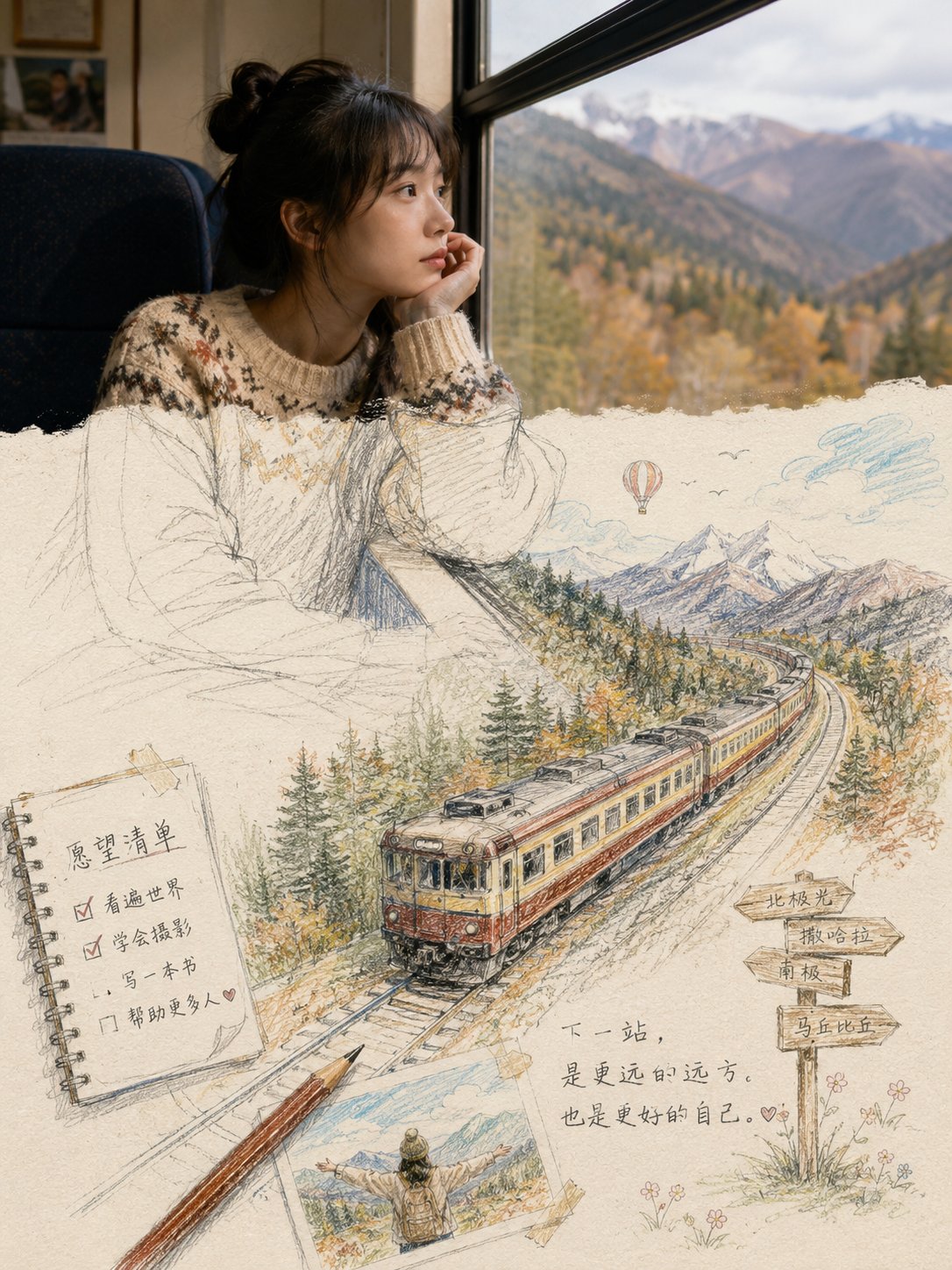
Using image 1 as the sole content reference, create a single 3:4 'photo continuation' visual. Keep the upper ~50% of the image as real photograph, strictly preserving the face, hairstyle, outfit, pose, main structure, perspective and light direction. Starting from a natural boundary at the mid-frame (such as horizon, table edge, hem, road or building base), let the real photograph gradually transition into a warm-white handmade paper. Outlines, roads, body or object edges from the photo must accurately cross the boundary and continue onto the paper as colored-pencil, crayon, watercolor or pen sketches. The hand-drawn area continues the 'unrealized scene, character's wish, making process, space structure, travel route', while preserving clearly visible paper fibers, pencil test lines, crayon color buildup, slight erasing, tape and irregular handcrafted edges. Hand-drawn colors are extracted from the real photo, limited to 3-5 colors. The photo and the sketch share the same subject, perspective and spatial direction — not a collage of two unrelated images. Avoid hard straight-line split screens, before/after layouts, grids, frame-in-frame collages, duplicated characters, changed faces, broken top-bottom perspective, too many sticky notes, fake long text and childlike homework feel. The real and the hand-drawn areas stay between 4:6 and 6:4, do not let either layer be reduced to a decorative corner. Arrange at least two outlines crossing the boundary to build continuity. The hand-drawn area continues only one information task — do not add maps, recipes, timelines and many notes at the same time. When dealing with real history, architectural restoration or craft processes, base the drawing on materials; clearly mark uncertain parts as imaginative continuation. One-line summary: the photo records the moment that has already happened, the sketch paints out the still-growing 'after'.
使用图一作为唯一内容参考,创作一张宽高比三比四的单幅"照片续写"视觉。保留图一上方约百分之五十的真实照片区域,严格保持人物面部、发型、服装、姿态、主体结构、场景透视与光线方向一致。从画面中部的自然边界开始,例如地平线、桌沿、衣摆、道路或建筑基座,让真实影像逐渐过渡为暖白色手工纸张。照片中的轮廓、道路、人物身体或物体边缘必须准确穿过边界,并在纸面上继续延伸成【彩色铅笔/蜡笔/水彩/钢笔手稿】。手绘区域续写【尚未发生的场景/人物愿望/制作过程/空间结构/旅行路线】,保留清楚可见的纸纤维、铅笔试线、蜡笔堆色、轻微擦除、胶带与不规则手工边缘。手绘颜色从真实照片中提取,控制在三至五种。照片与手稿共享同一个主体、透视和空间方向,不是两张无关图片的拼贴。禁止生硬直线分屏、前后对比图、宫格、相框套图、重复人物、面部变化、上下透视断裂、过多便签、虚假长文字和儿童作业感。真实与手绘区域保持四比六至六比四,不要让其中一层只剩装饰边角。至少安排两条轮廓跨过边界,才能建立连续感。手绘区域只续写一个信息任务,不要同时加入地图、配方、时间轴和大量说明。涉及真实历史、建筑复原或工艺流程时,应依据资料绘制;不确定的部分明确作为想象性续写。一句话总结:照片记录已经发生的瞬间,手稿替它画出仍在生长的以后。