For each uploaded travel photo, create one standalone "photo-embedded sketch page" work. Each photo must be output separately; do not combine multiple photos into a single frame.
Use a 3:4 vertical composition.
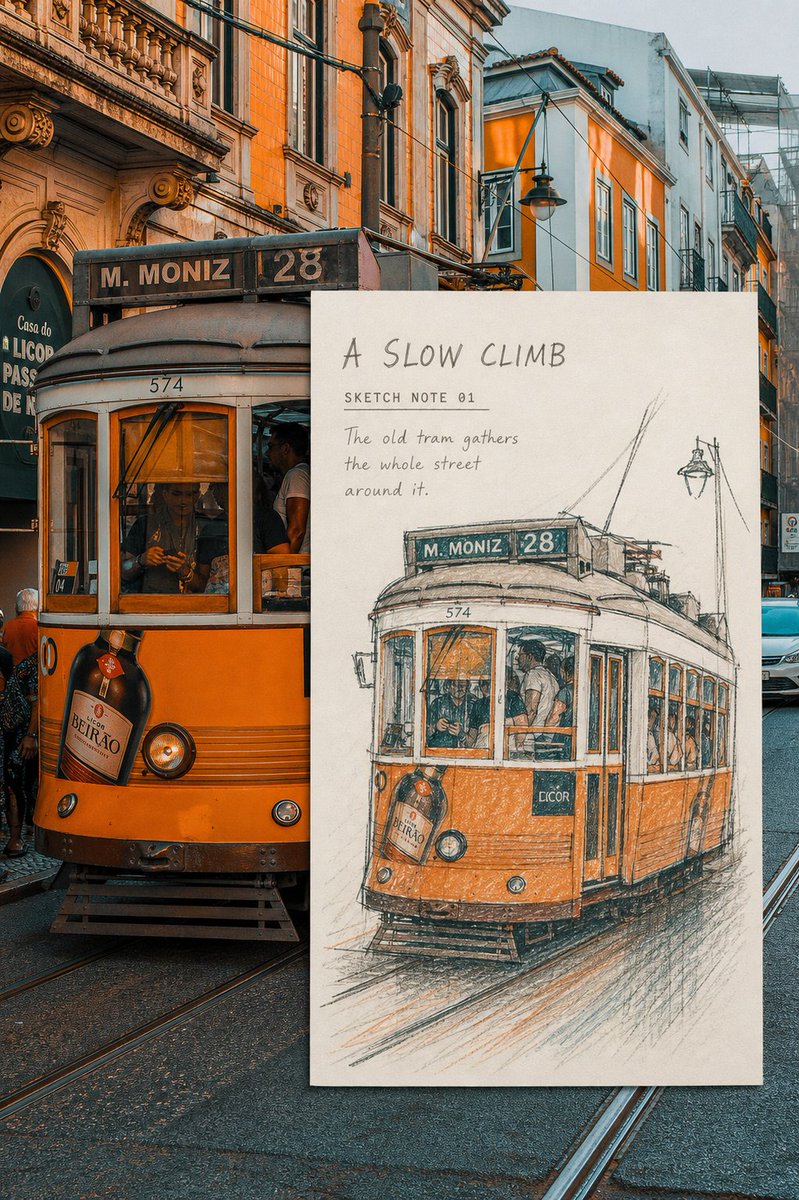
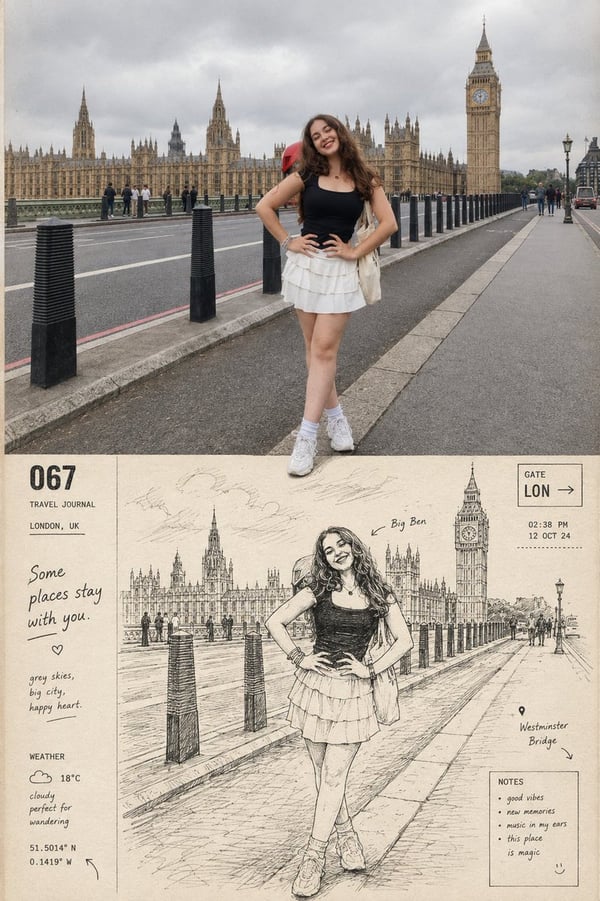
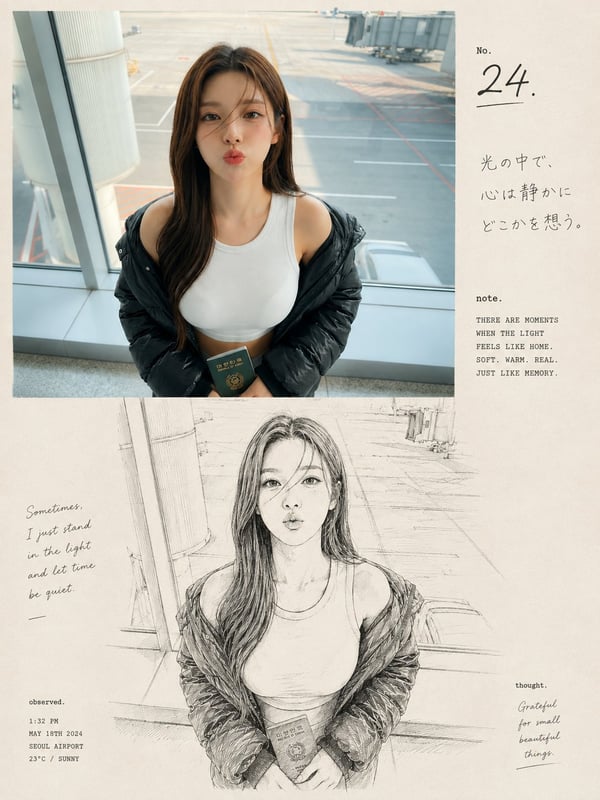
This is not a top-bottom diptych poster, nor a left-right comparison. The original photo should fill the entire frame, with a regular, flat warm-white drawing paper placed as a real foreground object over the photo, so the photo subject and the same-subject sketch on the paper appear together.
## Original photo
Fully preserve the subject identity, count of people or animals, pose, action direction, main clothing color, vehicle or boat structure, building relationships, terrain, viewing angle, natural light and shadow, and real materials in the original photo.
The original photo must fill the whole frame and remain clearly recognizable; only apply a slight art-book, travel-magazine, or photo-exhibition color grade, plus a very thin film grain.
Do not repaint the original photo as an illustration; do not move figures, change poses, swap buildings, add or remove subjects, distort vehicles, or redesign the environment.
## Foreground paper
Place a regular warm-white rectangular drawing paper inside the photo.
The paper sits between the photo and the viewer as the very front layer. People, vehicles, boats, buildings, trees and other objects in the photo must not pass in front of the paper, nor cover, cut, or hide the paper edge.
The paper may occlude part of the subject or environment, but enough of the real subject silhouette, clothing, action, vehicle structure, hull, road, or surroundings must remain outside the paper so the viewer can see at the same time:
1. the original subject in the real photo;
2. the hand-drawn redrawing of the same subject on the paper.
The paper occupies about 45–65% of the frame width and 38–58% of the frame height, placed at center, left, right, or upper area depending on the original subject position.
The paper may be portrait or landscape proportion, but must satisfy:
- four straight, complete, mutually parallel edges;
- four clear, regular corners;
- a stable paper ratio;
- a real but restrained paper fiber;
- only a very thin side thickness;
- a slight contact shadow between the paper and the photo.
Forbid: torn paper edges, deckle edges, postage perforations, custom die-cuts, curled paper corners, folded paper corners, wavy edges, broken notches, frames, tablets, or floating digital screens.
## On-paper sketch
The drawing on the paper must correspond to the same subject and the same moment as the photo.
Precisely extract the subject's most critical elements:
- overall silhouette;
- pose and action direction;
- body or object center of gravity;
- main clothing or object color;
- one or two necessary environment relationship lines.
Figures keep the original photo pose, orientation, count, and their relationships. Vehicles, boats, and buildings keep the most important identity structure and direction.
Do not shrink the full photo and redraw it on the paper, and do not depict every building, tree, window, passerby, and background. The paper only keeps one main visual anchor and one to three environment cues.
The sketch subject is concentrated in the middle-lower or one side of the paper, with about 45–70% of the paper interior left as undrawn warm-white negative space.
## Drawing medium
Use a travel-sketch language with obvious handmade traces:
- loose colored pencil;
- exploratory graphite lines;
- fine pen;
- wax crayon;
- dry chalk;
- repeated searching contours;
- broken lines;
- erased marks;
- uneven hand pressure;
- slight color outside the outline;
- visible paper grain.
Pull 2–4 colors from the original photo:
- one dark structural line;
- one warm accent line;
- one environment color;
- and a small graphite gray if needed.
Lines may hesitate, repeatedly search the contour, slightly cross over, and break mid-stroke. Local color blocks may not be fully filled in, retaining pencil grain, wax-crayon friction, and paper showing through.
Facial features of people must be softened or omitted. No realistic portrait, no fine rendering of skin, clothing folds, or tiny accessories.
## Text
Based on the real location, action, weather, or mood in the photo, extract and accurately render these three layers of text:
1. a handwritten main line of 3–7 English words;
2. the field "SKETCH NOTE 01";
3. a single observation line of 5–12 English words.
The main line should read like a short impression a traveler left at the moment, for example:
- "A SLOW STREET"
- "A STEADY OAR"
- "BETWEEN BRIDGES"
- "SMALL BOAT"
- "SOMEWHERE SOFT BETWEEN"
The observation line only describes the subject, action, color, or spatial relationship that truly exists in the photo. Do not invent location, identity, dates, or story.
Text must be written on the paper with the same colored pencil, pen, or graphite as the sketch, naturally intersecting a few lines. The main line must be clearly readable at chat-preview size; supporting text can be smaller but not reduced to decorative gray.
Forbid: author name, signature, social handle, logo, URL, QR code, coordinates, long paragraphs, fake Chinese, and garbled text.
## Overall mood
Like a traveler placing a freshly finished sketch lightly in front of the real scene, letting photo and drawing briefly overlap.
Real, quiet, human, slightly unfinished, with the feel of an independent travel magazine, art publication, and personal observation notebook.
Hard avoid: split poster, upper-photo lower-drawing comparison, separate lower paper panel, paper behind the subject, person or object covering the paper edge, subject crossing in front of paper, irregular torn paper, deckle edge, postage perforations, curled paper corners, folded paper, warped rectangle, floating screen, framed artwork mockup, full-photo sketch filter, unrelated drawing, changed pose, extra subject, detailed face rendering, dense background drawing, clean vector lines, fake signature, watermark.
请将我上传的每一张旅行照片分别制作成一张独立的"实景嵌画手稿"作品。每张照片单独输出,禁止把多张照片拼接在同一画面中。
整体采用3:4竖版构图。
这不是上下双联海报,也不是左图右图对比。原始照片应铺满整张画面,一张规则、平整的暖白色绘画纸作为真实前景物件覆盖在照片内部,使照片中的真实主体与纸上的同主体手稿同时出现。
## 原始照片
完整保留原始照片中的主体身份、人物或动物数量、姿态、动作方向、服装主色、车辆或船只结构、建筑关系、地形、观察角度、自然光影和真实材质。
原照片必须铺满全幅并保持清楚可辨,只进行轻微的艺术出版物、旅行杂志或摄影展调色,以及极薄的胶片颗粒。
不得把原照片重画成插画,不得移动人物、改变姿态、替换建筑、增减主体、扭曲车辆或重新设计环境。
## 前景画纸
在照片内部放置一张规则的暖白色矩形绘画纸。
画纸位于照片与观者之间,是整个画面的最前层。照片中的人物、车辆、船只、建筑、树木和其他物体都不能穿到纸张前面,也不能覆盖、切断或遮住纸张边缘。
画纸可以遮住照片主体或环境的一部分,但纸张外部必须保留足够的真实主体轮廓、服装、动作、车辆结构、船体、道路或周边环境,使观者能够同时看到:
1. 真实照片中的原始主体;
2. 纸张上对同一主体的手稿转绘。
画纸占整张画面宽度约45%–65%、高度约38%–58%,根据原照片主体位置放置在中央、偏左、偏右或偏上区域。
画纸可以使用竖向或横向比例,但必须满足:
- 四条边笔直、完整并互相平行;
- 四个角清楚、规整;
- 纸张比例稳定;
- 具有真实但克制的纸张纤维;
- 只有极薄的侧边厚度;
- 与照片之间产生轻微接触阴影。
禁止撕纸边、毛边、邮票齿孔、异形模切、卷曲纸角、折叠纸角、波浪边、破损缺口、相框、平板电脑或悬浮数字屏幕。
## 纸上手稿
纸张上的绘画必须对应照片中的同一主体和同一个瞬间。
准确提取主体最关键的:
- 整体轮廓;
- 姿态与动作方向;
- 身体或物体重心;
- 服装或物件主色;
- 一至两条必要环境关系线。
人物保持原照片中的姿态、朝向、数量及彼此关系。车辆、船只和建筑保持最重要的身份结构和方向。
不要把完整照片缩小后重新画进纸张,也不要描绘所有建筑、树林、窗户、路人和背景。纸面只保留一个主要视觉锚点及一至三条环境线索。
手稿主体集中在纸面中下部或一侧,画纸内部约45%–70%保持未经绘制的暖白色留白。
## 绘画媒介
使用具有明显手工痕迹的旅行速写语言:
- loose colored pencil;
- exploratory graphite lines;
- fine pen;
- wax crayon;
- dry chalk;
- repeated searching contours;
- broken lines;
- erased marks;
- uneven hand pressure;
- slight color outside the outline;
- visible paper grain.
从原照片中提取2–4种颜色:
- 一种深色结构线;
- 一种暖色强调线;
- 一种环境色;
- 必要时加入少量石墨灰。
线条可以迟疑、反复寻找轮廓、轻微越线和中途断开。局部色块允许不完全填满,保留铅笔颗粒、蜡笔摩擦和纸张透底。
人物五官必须弱化或省略。不要写实肖像,不要精细刻画皮肤、衣服褶皱和微小饰品。
## 文字
根据照片中的真实地点、动作、天气或情绪,提炼并准确渲染以下三层文字:
1. 一个3–7个英文单词的手写主句;
2. 字段:"SKETCH NOTE 01";
3. 一行5–12个英文单词的观察句。
主句应像旅行者当时留下的简短感受,例如:
- "A SLOW STREET"
- "A STEADY OAR"
- "BETWEEN BRIDGES"
- "SMALL BOAT"
- "SOMEWHERE SOFT BETWEEN"
观察句只描述照片中真实存在的主体、动作、颜色或空间关系。不得虚构地点、人物身份、日期和故事。
文字必须使用与手稿相同的彩铅、钢笔或石墨写入纸面,并与线条产生少量自然穿插。主句在聊天预览尺寸下应清楚可读,辅助文字可以较小,但不能缩成装饰灰线。
禁止作者名、签名、社交账号、Logo、网址、二维码、坐标、长段落、假中文和乱码。
## 整体气质
像旅行者把一页刚完成的速写轻轻放在真实现场前方,让照片与绘画发生短暂重合。
真实、安静、有人味、略带未完成感,具有独立旅行杂志、艺术出版物和个人观察手册的气质。
强制避免:split poster, upper-photo lower-drawing comparison, separate lower paper panel, paper behind the subject, person or object covering the paper edge, subject crossing in front of paper, irregular torn paper, deckled edge, postage perforations, curled paper corners, folded paper, warped rectangle, floating screen, framed artwork mockup, full-photo sketch filter, unrelated drawing, changed pose, extra subject, detailed face rendering, dense background drawing, clean vector lines, fake signature, watermark.